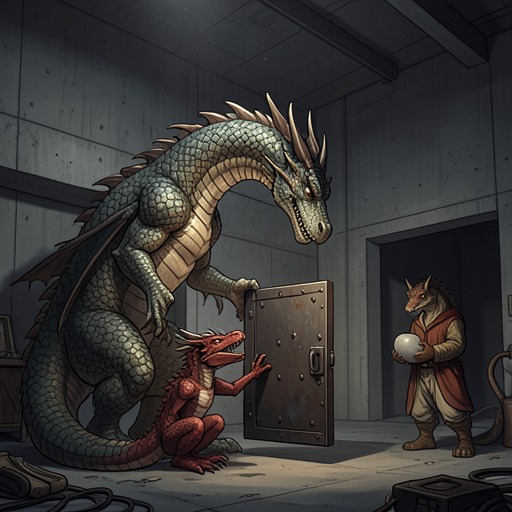
Jolie's First Bragging Day
Vainqueur the DragonJolie's First Bragging Day is both a family celebration and a concentrated display of dragon culture. For the young red dragon Jolie, it marks her first public presentation of a hoard and her entry into the lifelong pursuit of fame; for Vainqueur Knightsbane, it becomes an occasion to perform the role of indulgent uncle, revisit his own beginnings, and define affection through the bizarre economy of monsters, princesses, and treasure. The scene's warmth is inseparable from its violence, making the ceremony a miniature portrait of the society that produced him.
Occasion and Participants
Jolie's first Bragging Day is remembered when Genialissime prompts Vainqueur Knightsbane about the event and the solstice on which it is to occur. Vainqueur initially needs the reminder, but then recognizes it as Jolie's first Bragging Day and immediately travels to the cave near the riverbank where she is waiting. His arrival is not solitary: roughly half a dozen dragons have already gathered, establishing the celebration as a communal rite rather than a private exchange between relatives.
Jolie is a very young red dragon, barely the size of a large horse, and has only recently learned to fly. Her youth gives the ceremony its central emotional charge. The gathering does not judge her hoard by adult standards; instead, the attending dragons provide positive reinforcement for the effort she has already made. The event therefore treats accumulation as both material achievement and social performance. Jolie is expected to begin gathering fame early, while still having centuries ahead of her in which to become larger and more accomplished.
Vainqueur's Gift
Vainqueur arrives carrying a grocery bag and presents Jolie with what he considers an especially valuable gift: an elfling captive he identifies as a princess. Jolie first assumes that the present might be a minion, since another relative, Uncle Grognon, has given her a catkin kitten as her first minion. Vainqueur rejects that comparison and presents the captive as something better, turning the possession of a princess into a milestone in a dragon's development.
The gift is framed as a toy-like object even though it is a living captive. Vainqueur explains that the princess makes a whining sound when squeezed and warns Jolie about knights who may attempt to take her away. Jolie responds with delighted excitement, calling the captive her first princess and asking whether she can dress her. Vainqueur grants permission without qualification, and the exchange exposes the dragons' ability to convert domination into play. The scene's comic language does not erase the captive's fear; it sharpens the contrast between Jolie's joy and the elfling's distressed condition.
Vainqueur places the princess doll on Jolie's hoard inside the cave. The wording makes the object part of the ceremony's material logic: the captive is not merely an entertaining present but a new possession that enlarges the symbolic range of Jolie's collection. Jolie immediately imagines feeding her fish and carrying her toward the river, treating the captive according to the imaginative rules of a child's prized possession. Her delight confirms that the gift has succeeded according to Vainqueur's standards, even as it reveals the moral distance between dragon customs and the values of the smaller peoples they prey upon.
Hoard, Inheritance, and Memory
Jolie's hoard is still tiny, consisting of copper coins and the treasures she has managed to scrape together as a young wyrm. Its modesty does not diminish its importance. The gathered dragons celebrate the fact that she has begun collecting at such an early age, and the ceremony promises that fame can be pursued gradually rather than demanded all at once. The first Bragging Day thus establishes a life pattern: accumulate, display, receive admiration, and continue working toward a larger reputation.
The sight of Jolie with her new possession recalls Vainqueur's own first Bragging Day. His memory associates that earlier celebration with paying back the gold debt owed to his parent for bringing him into the world, presenting birth itself as an obligation recorded in the same economic language as treasure. Watching Jolie, he responds with genuine fondness and hopes that she will grow almost as large as he is over the next several centuries. His affection is expressed through comparison, scale, and future accumulation, but it is nevertheless unmistakably protective and familial.
Genialissime reinforces the intergenerational pattern by declaring that he may organize a Bragging Day of his own in roughly ten years, after the next Princess Hunt Season. Jolie's celebration is therefore not an isolated custom but part of a recurring calendar of dragon prestige. The Princess Hunt Season supplies future material for the hoards, while the Bragging Day provides the stage on which that material can be displayed. Celebration and predation are structurally linked: the social ritual depends on the violent acquisition of the things it celebrates.
Family Violence and the Dragon World
The gathering's apparent domesticity is shadowed by the history of Jolie's family. Vainqueur notes that Jolie's father had a birth disability, then identifies the condition as being killable. Her father was killed by elflings, and Vainqueur helped them commit assisted suicide afterward. The matter is delivered as part of ordinary family conversation, an indication that dragon kinship does not soften the species' habitual violence toward other peoples. Even an affectionate remembrance of a child’s celebration can contain references to murder and retaliation without breaking the scene's social rhythm.
Genialissime describes the spread of this vulnerability among dragons over the past ten centuries as though it were a plague carried by the puny races. His explanation turns mortality into an illness and non-dragon peoples into a contaminating force. The language makes dragon supremacy feel both arrogant and defensive: dragons regard themselves as the natural apex, yet their increasing susceptibility to being killed has become a collective anxiety. Jolie's first Bragging Day consequently carries a hidden question of survival. The child is being taught to gather possessions and fame in a world where even dragon blood no longer guarantees safety.
The scene ends by extending the family's plans from celebration to further conquest. Genialissime says that he and Blightswamp intend to raid a nearby dwarf city after Jolie has finished displaying her hoard. The transition is deliberately casual. A child's ceremony, the admiration of relatives, and an impending attack occupy the same continuum of dragon life. The Bragging Day does not civilize the dragons or suspend their predatory customs; it renews those customs by teaching the next generation what is worth possessing and how status is publicly confirmed.
Place in the Larger Narrative
The event also resonates with the book's recurring system of advancement. Vainqueur Knightsbane gains a level in the Noble class through sheer ego and noble dragon bloodline, while Victor Dalton gains the Monster Squire class by becoming the chief enforcer of a mighty dragon and later earns seven levels for leading monsters to victory against superior opponents. The class system translates inherited status, service, and battlefield success into explicit rewards. Jolie's ceremony operates outside those notifications, but it dramatizes the same principle: identity becomes power through recognized performance.
That contrast is especially revealing because the scene's most important reward is not a numerical increase but communal affirmation. Jolie's small hoard is treated as evidence of future greatness, and every dragon present encourages her to continue. The ceremony therefore functions as a social class system before it is a formal one. It teaches Jolie that treasure, princesses, fame, and public display are mutually reinforcing signs of what a dragon ought to become.
The event's later recollection, in which Genialissime asks whether Vainqueur became drunk from eating dwarves and recounts his violent rampage, complicates the earlier image of familial tenderness. Vainqueur's appetite once led him to consume three dwarves, burn everything, and insult Blightswamp while others tried to restrain him. Against that background, his careful preparation of Jolie's present and his hope for her growth appear less like a rejection of dragon brutality than an intimate expression of it. Jolie's First Bragging Day matters because it makes the dragon world look lovable without making it harmless: its rituals preserve affection, memory, hierarchy, and violence in one continuous inheritance.